ClearMax Labs is an access control system installation company for New York City offices, shops, clinics and multi-tenant floors. One written scope covers the readers, the locks on each door, the controller, the cable back to the network closet and the way every controlled door opens from the inside, drawn against the city's own building code rather than a model code. ClearMax technicians do the work on site, and the system is left with your business: the administrator login, the door list and the as-built records.
Last updated: November 2026
What kinds of New York spaces book this work?
Mostly tenants, not landlords. A ten-person firm on the 22nd floor of a Midtown tower that wants its own entry reader instead of a brass key. A Brooklyn loft office with a freight door, a rear stair and a server room. A Queens medical practice that buzzes visitors in by appointment.
Each of those spaces sits inside a building with its own rules: who may drill a corridor door, which closet the cable may run to, when the freight elevator is free and whether the lobby already has a badge system the tenant must work alongside. The scope starts from those rules, because in this city they set the order of the work more often than the hardware does.
From floor plan to door schedule
Before anything is priced, every opening on the plan gets a row in a door schedule. The row says what the door is for, who should pass through it and when, what frame and door it has today, and how it will open from the inside once it is locked electrically. A typical small office ends up with four to eight rows:
- The tenant entry from the elevator lobby or the public corridor.
- A second exit, often to a stair, that must stay usable at all times.
- The network or IT closet, where the controller will live.
- A records room, stockroom or cash room with a short list of people.
- A rear, freight or loading door with deliveries at set hours.
- Any door the landlord already controls, marked so nobody touches it.
The schedule becomes the scope, the drawing the landlord reviews and, at the end, the handover record.
Card, fob or phone at the reader?
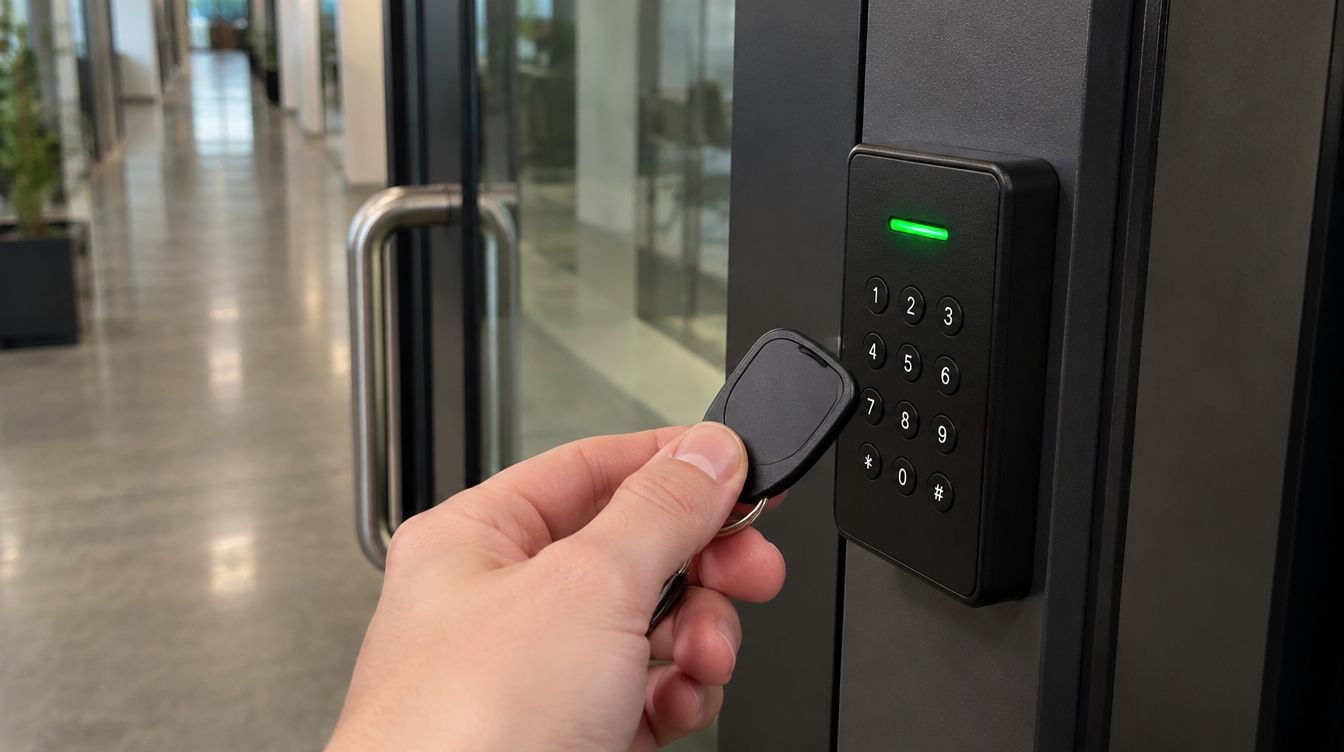
Most New York offices end up with a mix. Cards suit staff who already wear a building badge on a lanyard, and many new readers can read the building's card and the tenant's own credential on one device. Fobs survive a pocket full of keys. Phone credentials suit teams that hire often, because a new hire's access can be issued before day one and pulled the afternoon someone leaves, without anyone collecting plastic.
A reader is placed where a person in a wheelchair can use it as easily as anyone else. An unobstructed forward reach tops out at 48 inches and bottoms out at 15. Controls must work with one hand and no tight grasping, pinching or twisting of the wrist. Readers, keypads and exit buttons are therefore mounted inside that range, and the drawing shows the height for each.
How is each New York door locked?
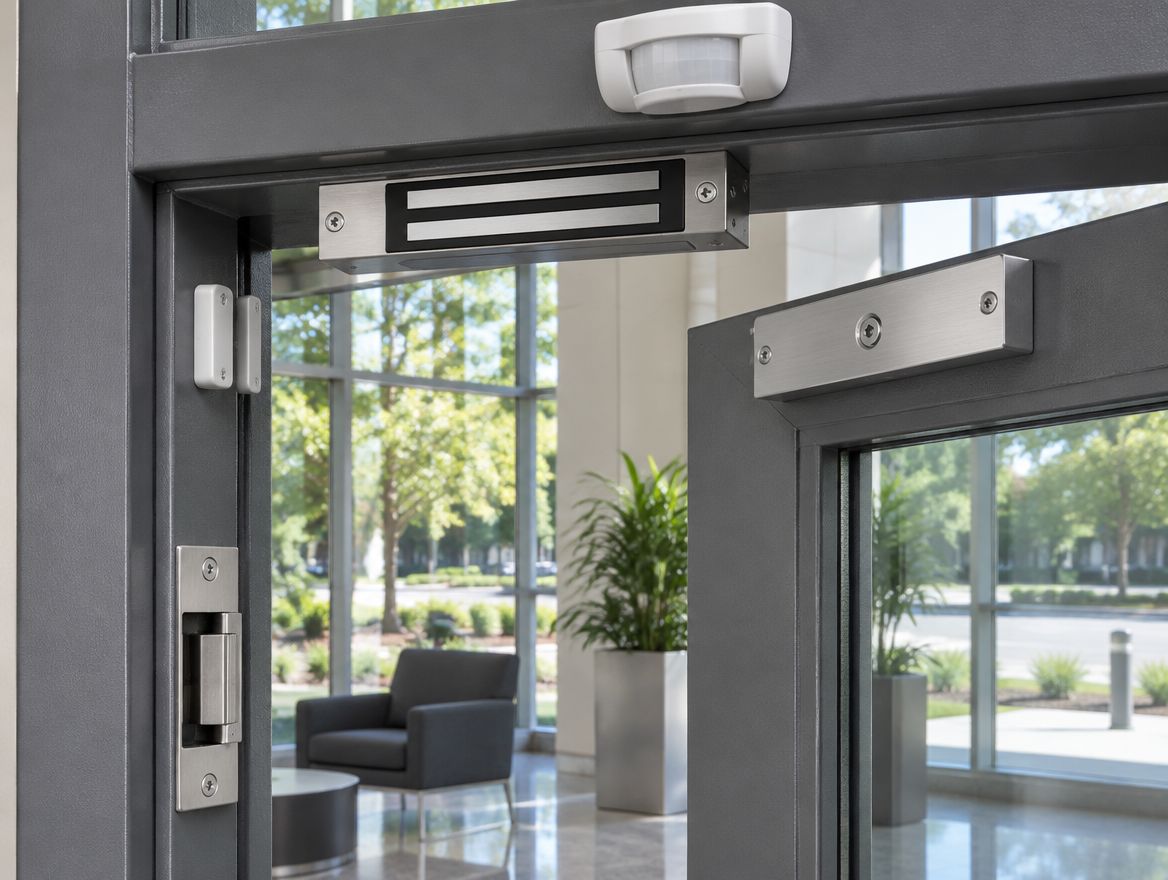
By one of two families of hardware, chosen door by door. An electric strike replaces the strike plate in the frame and lets the latch pass when a valid credential is read; the lever and the latch still do the job of letting people out. A maglock holds the door with a magnet mounted on the frame header and opens when its power is cut.
New York limits where and how a maglock may go on a door people use to leave. A maglock is allowed on these doors only with door hardware that has a switch built into it. That hardware has to work with one hand. Working the hardware must cut the maglock's power directly and free the door at once. Where panic or fire exit hardware is required, pushing it must release the maglock too. In practice that means a switched lever set or a switched bar, wired into the lock's power, on the inside of every maglock door that serves as a way out.
Storefront aluminum, hollow metal and wood doors each take different hardware, and a glass door often rules out a strike entirely. Photos of each door and frame, taken from both sides, usually settle the choice before a site visit. Operable door hardware sits between 34 and 48 inches above the floor.
Sensor exits and the PUSH TO EXIT button
Some doors open from the inside by motion rather than by a lever, which suits glass entries and doors people approach carrying things. The city code sets out how those doors must behave.
- New York's own building code lets sensor-released electric locks sit on egress doors in Group A, B, E, M, R-1 and R-2 buildings.
- The sensor goes on the inside, aimed at people walking toward the door.
- When the lock loses power, the door has to unlock by itself.
- The manual exit device belongs 40 to 48 inches above the floor and no more than 5 feet from the door. Pressing it must cut the lock's power directly, apart from any other electronics, and the door must remain unlocked for at least 30 seconds.
- Where the building has a fire alarm system, its activation must unlock these doors until that system is reset.
- The locking units themselves must carry a UL 294 listing.
The point for a tenant is the wiring. The exit button is not only a signal to the controller; it sits in the lock's power path, so the door opens even if the controller is busy, offline or mid-update. The scope shows that circuit for every sensor door.
Is delayed egress an option in this city?
Rarely, and never as a default. A delayed egress lock holds a door for a short time after someone pushes it, which some stockrooms and clinics ask about. Delayed egress locks in New York need special review and approval by the Buildings commissioner. The city does not permit them at all in Group A, E, F and H spaces. If a door seems to need one, the scope flags it as a question for the building's architect or engineer, and the job proceeds on the other doors meanwhile.
Lobby turnstiles
Many Manhattan towers already run turnstiles in the lobby, owned by the building. A tenant project usually starts above them, at the floor entry. Where an owner wants turnstiles added, they are treated as an egress item, not a reader upgrade. Every automatic turnstile on an egress path has to be connected to the building's fire alarm system. Breaking one away by hand can take no more than 13 pounds of force.
Where the controller lives and how the cable gets there
The controller is a small panel with its power supply and backup battery, mounted in the network closet next to the switch it talks to. Each door gets a home run of cable back to it: the reader, the lock power, the door position contact and the exit device. In older New York buildings the hard part is the route, not the panel. Plaster walls, landmark trim and crowded shared risers all shape the path.
Work is booked around the building's rules. Many towers allow drilling and cable pulls only after hours, require a certificate of insurance before the crew arrives and reserve the freight elevator by the slot. The schedule in the scope lists those windows so the ready date stays realistic.
Several floors, a second office, one people list
A firm that takes a second floor, or opens a Brooklyn location next to a Manhattan one, can run both from one system. One people list, one set of schedules, one place to remove a departing employee from every door at once. Each site gets its own controller so it keeps working if the link between buildings drops, and the administrator sees every door from one screen.
Door cameras, with the audio left off
A camera at a controlled door answers the question the door log cannot: who actually walked through behind the badge. Cameras are added to the same cable plan and recorded to a recorder at your space or to a system your business already runs. No one outside your business watches the video.
Microphones stay switched off. New York defines mechanical overhearing as recording a conversation without consent from at least one party to it, by someone not present. People talking near a door are rarely parties to anything the camera owner consented to, so video only is the house setting.
Entry intercom and the service plan
A locked entry still needs a way for visitors, couriers and clients to get in. An entry intercom puts a call station at the door, answered from the front desk or a phone, and releases the same lock the readers use. After handover, an access control service plan keeps the people list current and tests every exit on a schedule.
What New York tenants ask before signing
Do we have to commit to one hardware maker?
No. Every reader, lock and controller in the scope is described by type and function, and the choice is made on the door, the budget and what the building already runs. Your business owns the system and the administrator login, so a later contractor can service it.
Our landlord already runs the lobby system. Can ours sit beside it?
Usually yes. The tenant system controls the tenant's doors and leaves the building's doors alone. Where a reader can read both credentials, staff carry one card. The landlord sees the hardware schedule before any corridor or stair door is touched.
Can the old keypad or card system stay in service during the change?
Often, door by door. The new hardware goes in one opening at a time, and each door is switched over only after it is tested from both sides.
What is the best first message to send?
The address and floor, a rough list of the doors you want controlled, your head count, the date the space must be ready and photos of each door from both sides. The project form has room for all of it.